
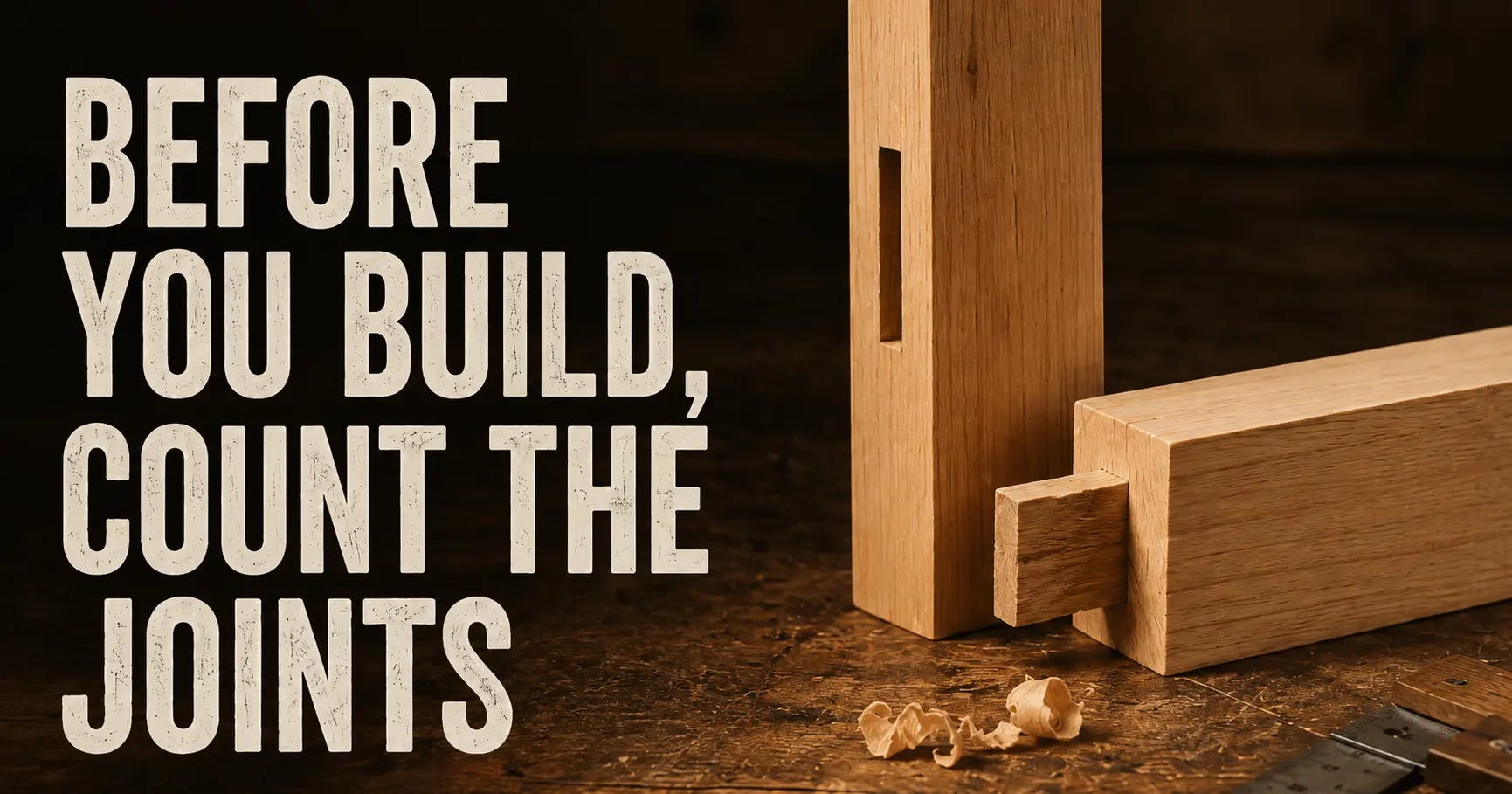
Before you build, count the joints
A simple way to tell if your first project is going to teach you or fight you.

You told me where to go next.
Half of you picked a full project build.
That tracks. Sharpening matters. Joinery matters. Tool choice matters. But sooner or later, you have to stop fussing with the bench and put boards together.
So I want to start small.
Not tiny. Tiny projects lie to you. A little box can be harder than a side table because every bad corner is right there in your hand, staring back at you.
But small enough that you can see the whole thing before you cut.
That’s the part beginners skip.
They see the finished piece and start thinking about wood, tools, finish, hardware, and whether the thing will look good in the living room.
Slow down.
Count the joints first.
Watch the corner.
That’s the whole lesson.
A project is just a pile of joints pretending to be furniture. If the joint seats cleanly, the project starts behaving. If the joint is sloppy, every step after that becomes an apology.
Glue won’t fix it.
Clamps won’t fix it.
Sanding definitely won’t fix it. Sanding is where bad joinery goes to become rounded bad joinery.
For your first real build, I’d pick something with a boring joint count.
A small wall shelf. A low bookcase. A side table if you’re ready for legs and aprons.
Nothing clever.
Choose one joint and repeat it until your hands start to understand what your head keeps overthinking.
A side table is a good example. Four legs. Four aprons. One top. If you use mortise and tenon joinery, you get 8 chances to cut the same joint.
The first one may be ugly.
The second one will probably still be ugly.
By the eighth, you’ll know something you can’t learn from watching a man in a clean apron cut one perfect joint on YouTube.
Use decent wood if you can.
Poplar is fine. Soft maple is better. Cherry if you want to enjoy yourself.
I’d still skip construction pine for this. It moves around, dents if you look at it wrong, and makes new woodworkers think the problem is their hands when the board itself is acting like wet toast.
Your small job this week:
Pick one project and write down the joint count before you buy wood.
Not the finish.
Not the tool list.
Just the joint count.
If the number scares you, pick a smaller project. If the project uses 4 different joints, strip it back until it uses 1.
That’s how you get a first build that teaches instead of punishes.
Reply and tell me what you’re thinking about building. If it’s a good beginner project, I’ll tell you. If it’s a trap, I’ll tell you that too.
Ted